As I was walking down the street one quiet afternoon, I heard a faint, broken barking echoing from a nearby alley. At first, I thought it might just be another neighborhood dog reacting to passersby, but there was something different about this sound. It wasn’t loud or territorial. It was weak. Fragile. Almost like a plea. Curiosity mixed with concern pulled me toward the narrow alleyway, and with each step I felt an unexplainable heaviness settling in my chest.

When I turned the corner, the sight before me stopped me in my tracks.
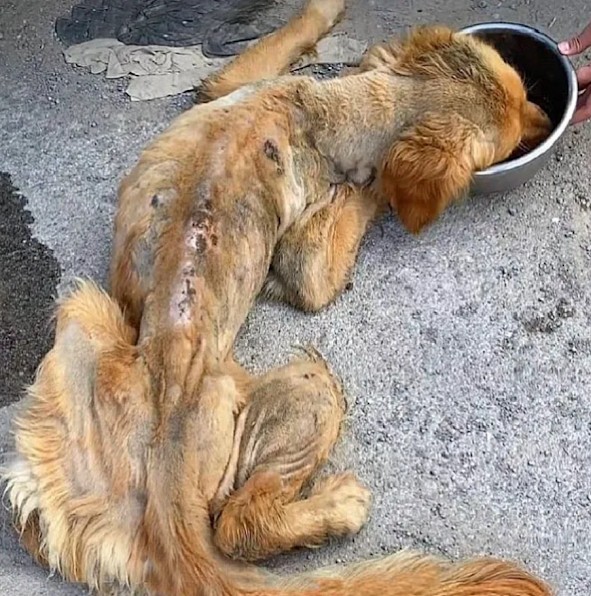
A small stray dog lay sprawled on the cold, uneven ground. Its body was painfully thin, ribs sharply visible beneath patchy fur that had fallen away in places due to what appeared to be a severe skin disease. Its coat, once perhaps soft and full, was now rough and broken. The dog tried to lift its head when it noticed me, but the effort seemed too much. Its legs trembled beneath it, unable to support its own weight. The alley smelled of damp concrete and neglect, and it was clear the little creature had been there for quite some time.
For a moment, I simply stood there, my heart pounding. I didn’t want to frighten it, so I approached slowly, speaking in a soft voice. The dog’s eyes met mine—tired, sunken, yet still holding a faint spark of awareness. There was no aggression in its gaze, no fear-driven growl. Only exhaustion. Only need.
I knelt down and took a closer look. Its skin was inflamed and irritated, with visible sores and bald patches. Every bone in its body seemed to press against its fragile frame. I could tell it hadn’t eaten properly in days, maybe even longer. Carefully, I offered it a small bottle of water I had with me, tilting it gently toward its mouth. The dog attempted to lick at it, but it was too weak. The effort alone made it shiver.
In that moment, I realized this was no situation that could wait. The dog needed food, water, and medical care immediately. Leaving it there without doing something felt impossible. My mind raced. I didn’t have supplies with me, but I knew I could get some quickly.
Without hesitation, I stood up and rushed to my tricycle, pedaling as fast as I could back home. The image of the dog’s frail body haunted me the entire ride. I kept thinking about how long it must have suffered alone, how many people might have passed by without noticing—or worse, without caring. The thought tightened my chest.
When I reached home, I grabbed a bowl, some leftover rice mixed with bits of meat, and more clean water. I also found an old towel that could help keep the dog warm. My movements were hurried but careful. I didn’t want to waste a second. Then I pedaled back to the alley, my heart pounding with both urgency and hope.
To my surprise and relief, when I returned, I wasn’t alone.

My friend Dayao was kneeling beside the dog. He looked up as I approached, his expression a mixture of concern and determination. Dayao has always had a soft spot for animals, and it didn’t surprise me that he had stopped when he saw what was happening. Without exchanging many words, we both understood what needed to be done.
Together, we gently placed the bowl of food in front of the dog. At first, it barely moved. Then, as the scent reached it, something shifted. With trembling effort, it dragged itself closer and began to eat. The change was immediate and heartbreaking. The dog devoured the food as if it hadn’t tasted a proper meal in weeks. Each bite was desperate, urgent. We had to slow it down slightly to prevent it from choking, but the hunger in its eyes was undeniable.
Watching it eat stirred something deep within me—a mixture of sadness and relief. Sadness for the suffering it had endured, relief that we had arrived in time to at least ease its hunger. After finishing the food, the dog drank small amounts of water, still weak but slightly more responsive.
Dayao carefully draped the towel over its thin body. We spoke softly, trying to comfort it. For a brief moment, the dog rested its head on the ground and closed its eyes—not in defeat this time, but perhaps in the smallest sense of safety.
However, it was clear that food alone would not solve the problem. The dog attempted to stand but wobbled and collapsed again. Its skin condition looked painful and advanced. The sores needed treatment. Its weakness suggested prolonged malnutrition. Whether it had been abandoned or had wandered too far from home, it was obvious that survival on the streets had nearly claimed its life.
“We can’t leave it here,” Dayao said quietly.
I nodded. The only real option was to take the dog to a shelter where professionals could provide proper medical care. The nearest animal shelter wasn’t exactly close, and transporting the dog would not be easy, but neither of us hesitated.

Using the towel, we carefully lifted the fragile body. It was lighter than I expected—far too light. The dog let out a faint whimper but did not resist. Perhaps it sensed that we meant no harm. We secured it gently on the tricycle, making sure it was as comfortable as possible.
The journey to the shelter felt longer than usual. Every bump in the road made us worry we were causing the dog discomfort. Dayao walked beside the tricycle, one hand steadying the towel-wrapped pup. I pedaled slowly, cautiously. Along the way, a few people glanced at us curiously, but we remained focused.
I kept glancing back at the dog. Its head rested low, eyes half-open. It seemed exhausted, yet calmer than before. I wondered what it had experienced—how many nights it had slept hungry, how many days it had searched for scraps of food. I wondered if it had once belonged to someone, if it had once known warmth and care.

When we finally reached the shelter, relief washed over me. The staff quickly noticed the urgency of the situation. They approached with gentle efficiency, asking brief questions while carefully examining the dog. Within moments, they carried it inside for a thorough assessment.
Standing there, watching the doors close behind them, I felt a wave of emotion I hadn’t expected. My body was tired, my clothes slightly dirty from kneeling in the alley, but none of that mattered. What mattered was that the dog was no longer alone. It was no longer invisible.
Dayao placed a hand on my shoulder. “We did what we could,” he said.
And he was right.

On the ride home, everything felt different. The same streets, the same buildings—but my perspective had shifted. I realized how easy it is to overlook suffering when we are busy with our own lives. How often do we hear faint cries and choose not to follow them? How many small opportunities to help pass us by because they seem inconvenient?
That day taught me that compassion does not require wealth, status, or extraordinary ability. It requires awareness. It requires the willingness to stop, to care, and to act.
The image of the dog’s fragile body in that alley will stay with me for a long time. But so will the memory of it eating with renewed strength, of its small moment of relief wrapped in an old towel, of the quiet hope that accompanied us to the shelter.
I don’t know what the future holds for that little dog. Perhaps it will recover fully and find a loving home. Perhaps its journey will continue to be difficult. But I do know that, for at least one turning point in its life, it was seen. It was helped. It was given another chance.

This experience profoundly affected me. It reminded me that small acts of kindness can ripple outward in ways we may never fully understand. A simple decision to investigate a faint bark changed the course of a living being’s life. And in doing so, it changed mine as well.
Each of us carries the power to make a difference. We may not solve every problem in the world, but we can choose not to ignore the suffering placed directly before us. Compassion is not measured by grand gestures; it is measured by the quiet moments when we decide to care.
Whenever I walk past that alley now, I no longer hear faint barking. Instead, I hear a reminder—a reminder that kindness matters, that action matters, and that even the smallest effort can offer hope to a creature who has nearly lost it.

Thank you for reading this story and for taking a moment to reflect on the power of empathy. May it encourage you, as it encouraged me, to pause when you hear a cry for help and to remember that sometimes, being human simply means choosing to be kind.