
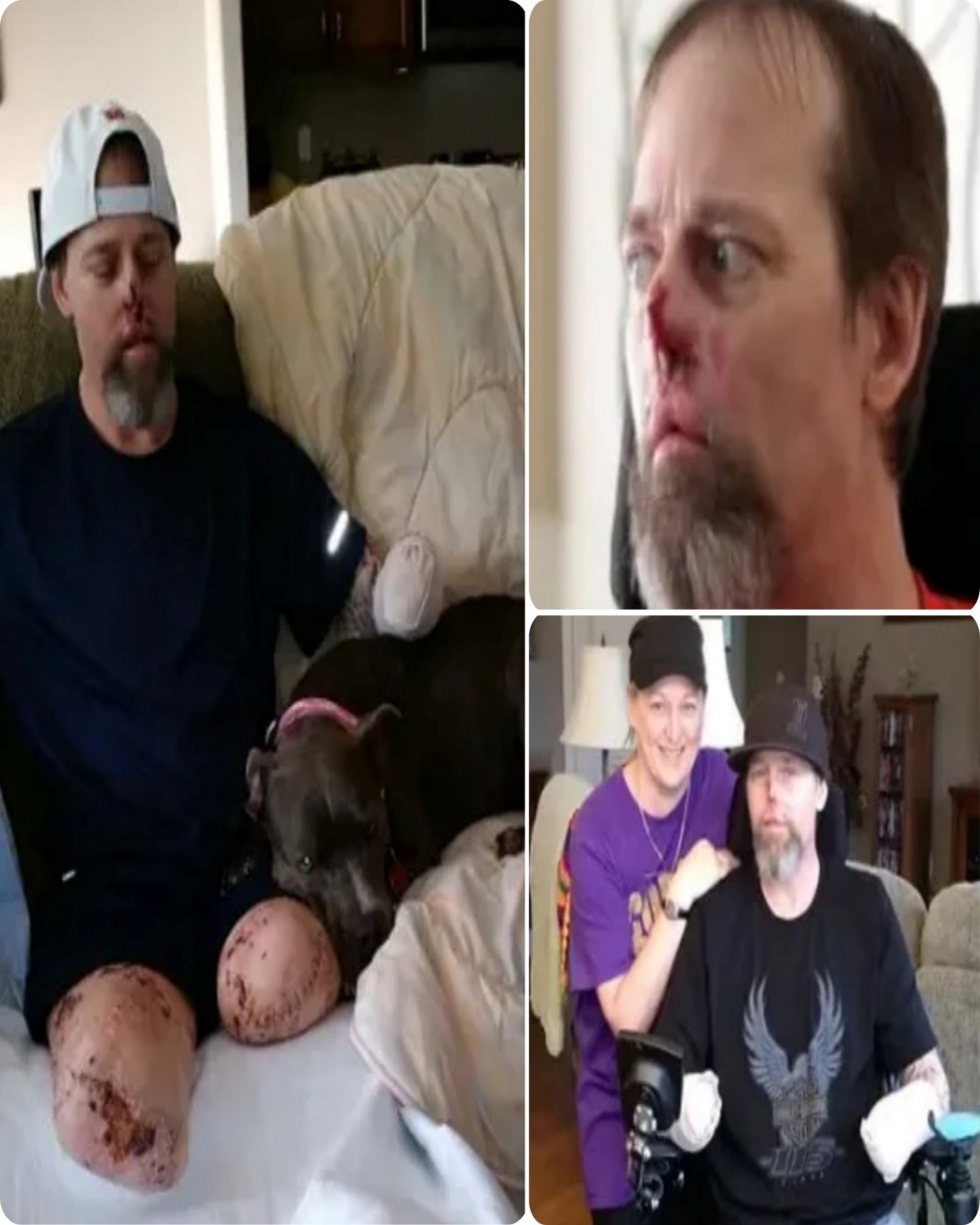
Greg woke up believing it was nothing more than the flu. A mild fever. A little body ache. The kind of sickness people push through without a second thought. He expected rest would fix it, that by morning he’d feel like himself again. But as the day unfolded, his body told a different story—one that moved with terrifying speed.
By nightfall, his skin began to darken into a deep, bruised purple. His blood pressure dropped. His organs started to fail. Doctors rushed him into intensive care as alarms filled the room and time began slipping through their hands. What looked ordinary hours earlier had become a fight for survival.
To save his life, they made a decision no one is ever prepared to hear.
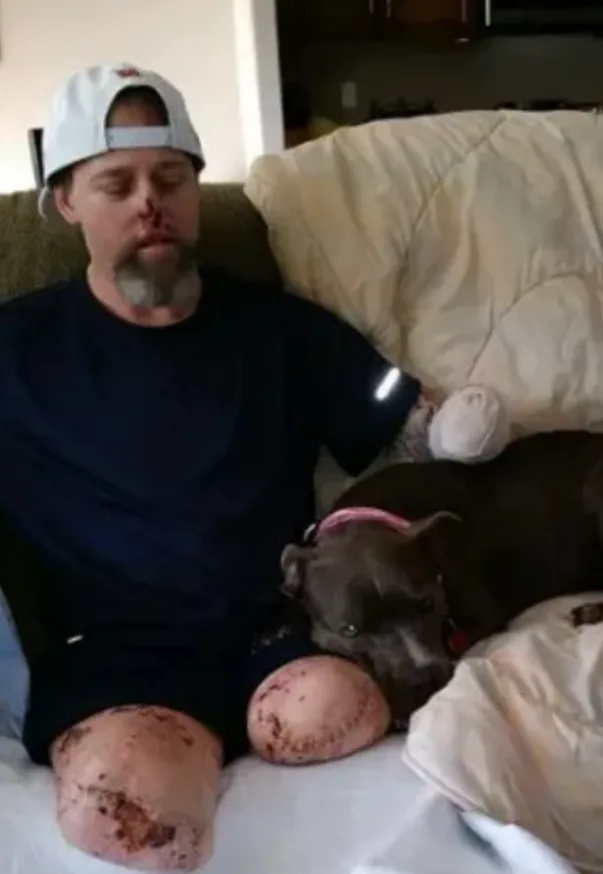
Both of Greg’s legs had to be amputated.
The cause wasn’t an accident.
It wasn’t violence.
It wasn’t recklessness.
It was a loving lick from his dog—carrying a rare bacteria so uncommon that almost no one ever thinks twice about it. A microscopic transfer that turned into overwhelming sepsis, shutting his body down from the inside out before anyone could stop it.
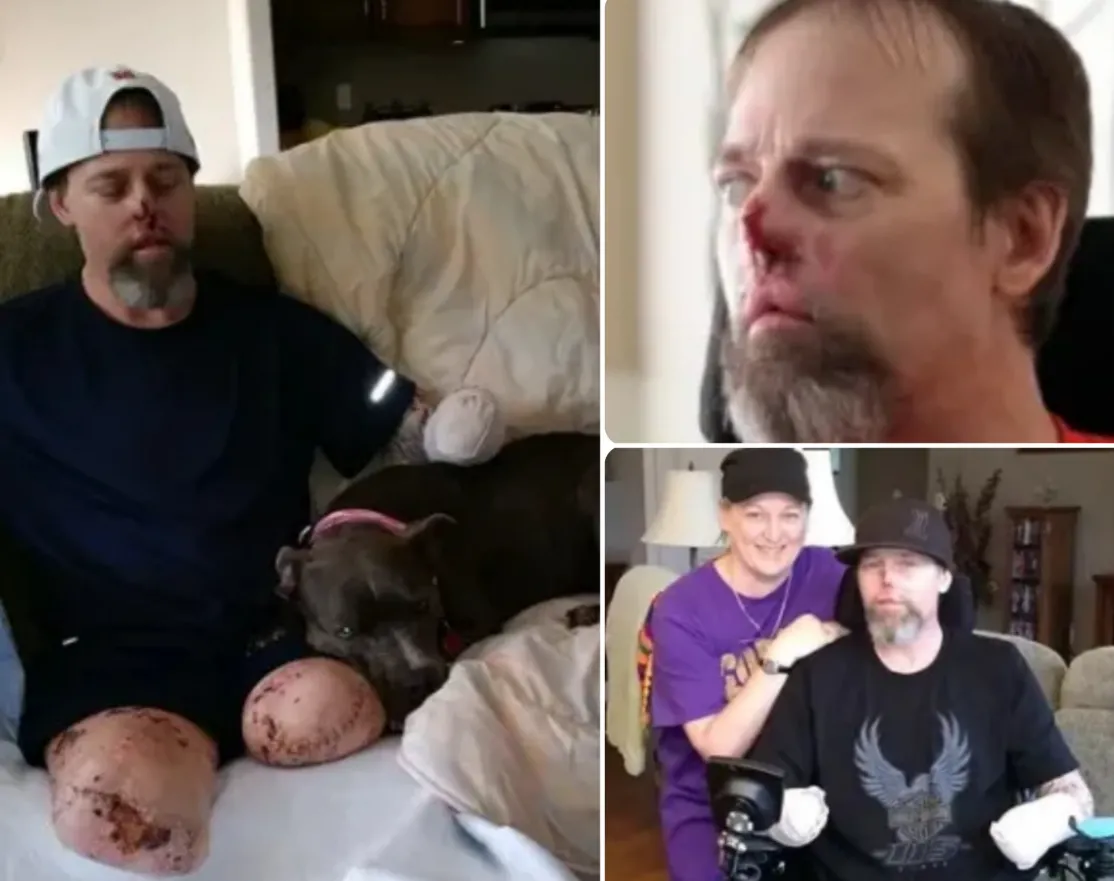
In the days that followed, Greg lost more than his legs. He lost parts of his hands. Parts of his face. Parts of the life he had known—the independence, the routine, the future he once assumed was guaranteed. Hospital rooms replaced normal days. Pain replaced familiarity. Mirrors became reminders of how suddenly everything had changed.
But something remarkable never left him.
Greg never blamed his dog.
While many would have turned anger into armor, Greg chose love instead. He refused to see the animal he adored as the reason for his suffering. “Love didn’t cause this,” he said. “Love is what helped me survive it.” In a moment when bitterness would have been understandable, he chose compassion—toward his dog, toward his body, and toward himself.
Recovery was not fast. It was not easy. It was not linear.
Greg had to relearn how to live—how to balance, how to walk again with prosthetics, how to dress himself, how to navigate a world that no longer met him at eye level. Every task that once required no thought became a mountain to climb. There were days of frustration, grief, and exhaustion. Days when survival didn’t feel heroic at all—just heavy.
But step by step, he moved forward.
He learned to stand again.
To walk again.
To build a new version of independence, piece by piece.
Survival, he learned, is its own kind of courage. Not loud. Not cinematic. Just relentless. Choosing to show up every day in a body that has been changed forever. Choosing to love a life that looks nothing like the one you planned.
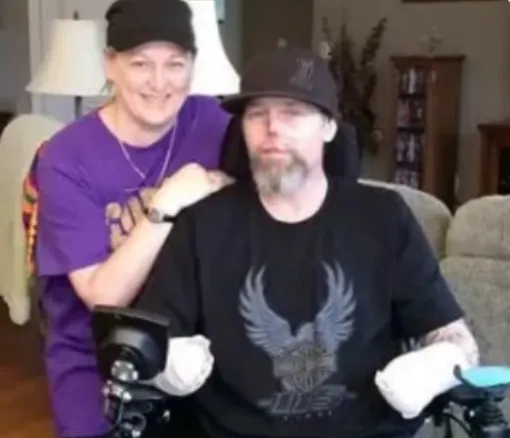
Greg’s story is a reminder of how fragile the human body can be—and how powerful the human spirit is in response. It shows how quickly normal can disappear, and how resilience doesn’t always mean bouncing back, but learning how to move forward with grace.
He lost his legs.
He lost parts of his body.
But he never lost himself.
And through it all, he held onto the thing that saved him in the end: love—not fear, not blame, not regret, but love strong enough to carry him through the unthinkable.
May you like
The horse who waited in the snow for seven months and proved that hope can survive even the cruelest winter 5447
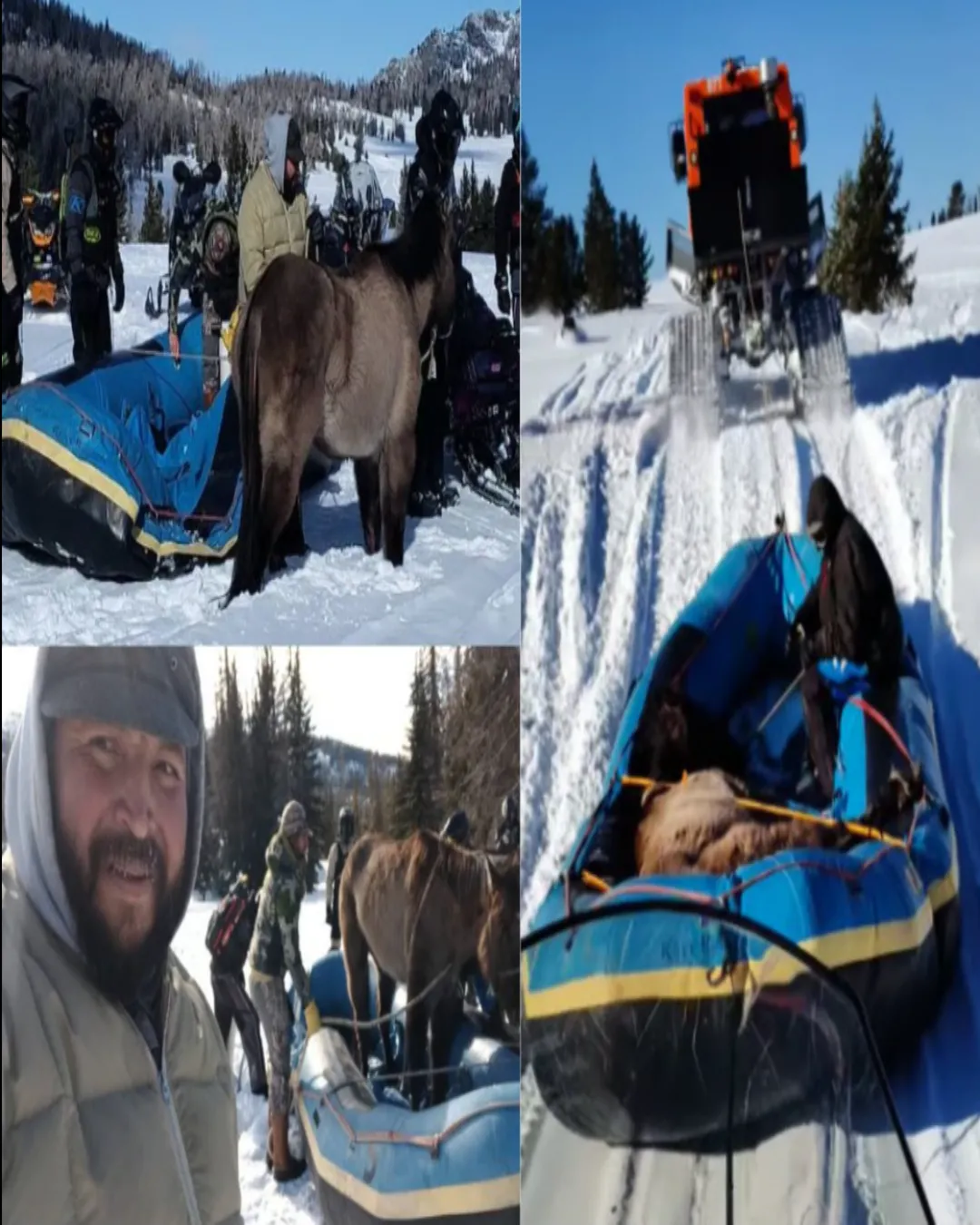
In July, a horse named Mouse vanished into the vast Wyoming wilderness, and no one imagined that his story would stretch across seasons, storms, and nearly two hundred days of survival. He was part of a packing trip in the Wind River Range when something startled him, and in a split second of instinct and fear, he bolted. Within moments, he disappeared into the mountains, swallowed by trees, rock, and distance. His owners searched immediately, calling his name into open valleys, scanning ridgelines, and following faint signs that vanished as quickly as they appeared.
Days passed without answers. Then weeks. They expanded their search, refusing to accept that Mouse was simply gone. But the wilderness does not give explanations, and gradually, hope had to compete with reality. Summer faded into fall, temperatures dropped, and the terrain grew more hostile with each passing day. The idea that a domestic horse could survive alone in such conditions began to feel impossible.
By the time winter arrived, the mountains were transformed into something unforgiving and lethal. Snow piled up more than seven feet deep. Temperatures plunged well below zero. Winds howled through the range, stripping warmth from anything exposed. Most people quietly assumed the worst. Predators. Starvation. Freezing nights. The kind of ending that so many lost animals meet in the wild. Mouse became a story spoken in past tense.
But Mouse was still there.
Somewhere beneath the endless white, alone and unseen, he endured. Without shelter. Without consistent food. Without human care. Day after day, night after night, he survived conditions that seemed incompatible with life. He learned when to move and when to stay still. Where to stand against the wind. How to conserve what little energy he had. And most importantly, how to wait.
For nearly seven months, Mouse remained in the backcountry as storms rolled over the mountains again and again. Each snowfall buried the land deeper, erasing tracks and swallowing landmarks. The world became quieter, harsher, and more isolating. Yet Mouse did not collapse. He did not wander aimlessly. He stayed.
Then, in mid-January, when winter had reached its most brutal point, fate intervened.
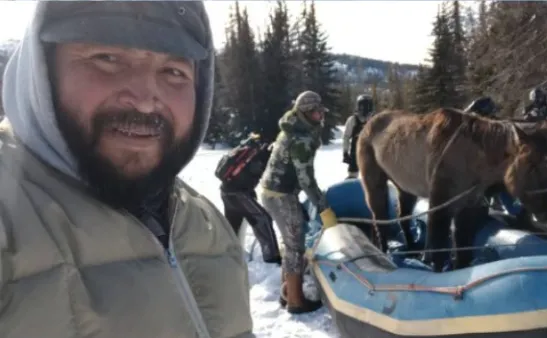
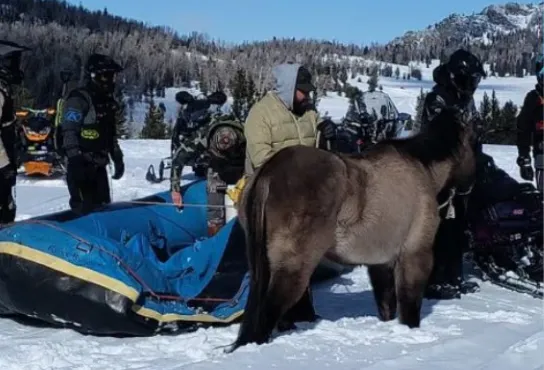
A snowmobiler was traveling through the area when something caught his eye—a dark shape breaking the uniform white of the landscape. At first, it didn’t make sense. It was standing upright, motionless, chest-deep in snow. As he drew closer, the truth became clear. It was a horse.
It was Mouse.
Alive.
The discovery stunned everyone. After seven months alone in one of the harshest environments imaginable, Mouse was still standing. Thin, exhausted, but alive. Yet finding him was only the beginning of another challenge. The snow was far too deep for a weakened horse to walk through, and leaving him behind was not an option.
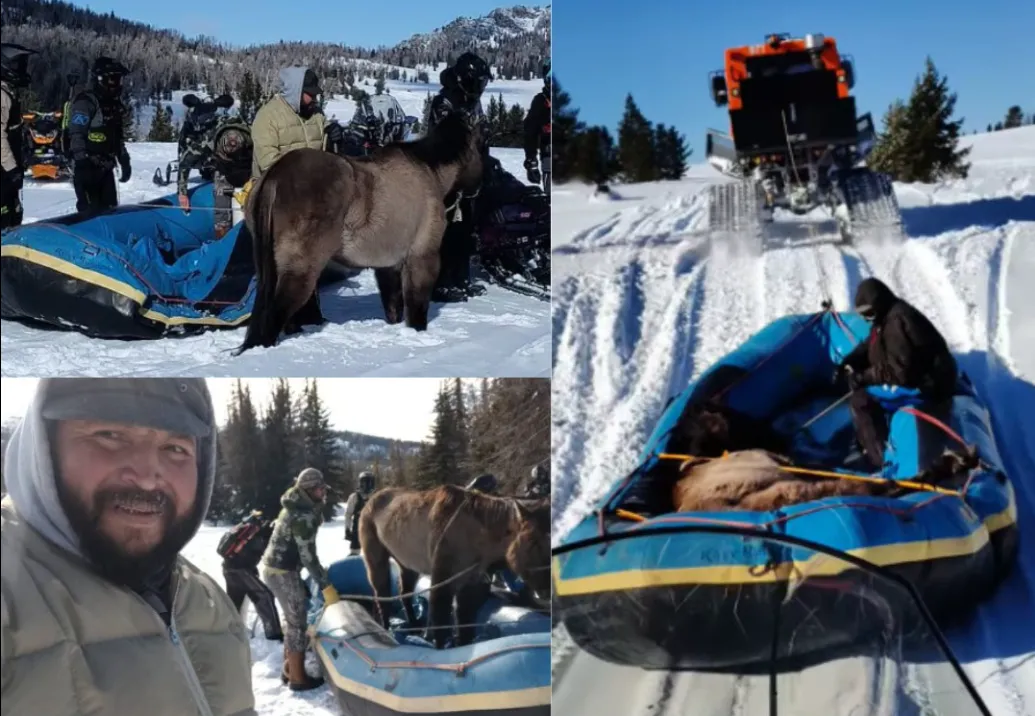
Rescuers and volunteers began planning a solution that would normally sound absurd. Snowmobiles were brought in. A snowcat followed. And finally, something no one expected—a whitewater raft. There was no traditional way to move a 1,000-pound horse through snow this deep, so creativity replaced convention.
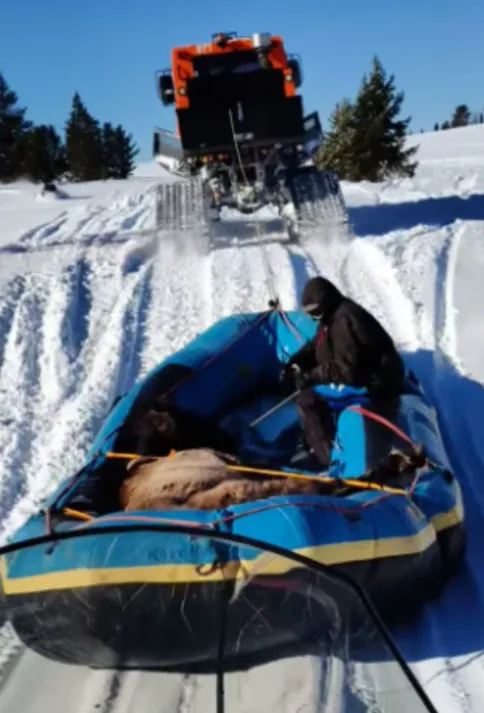
Carefully, they loaded Mouse into the raft, securing him as gently as possible. Then, across the frozen landscape, they began towing him out of the wilderness. A real-life “one horse open sleigh,” sliding over drifts that had nearly claimed his life.
What struck everyone most was Mouse’s behavior.
He didn’t panic.
He didn’t fight.
He stood calmly, steady and quiet, as if he understood that the waiting was over.
Meter by meter, the raft moved forward. Cold winds followed them. Snow stretched endlessly in every direction. But Mouse remained still, trusting the hands that had come back for him. When they finally reached safety, the reality settled in—Mouse had survived nearly 200 days alone in the wild.
His story spread quickly, not because it was dramatic, but because it was powerful. Mouse did not outrun the wilderness. He did not conquer it. He endured it. He waited. He held on long after the world assumed he was gone.
Sometimes survival isn’t loud or heroic.
Sometimes it looks like standing quietly in the snow, believing that someone might still be looking.