
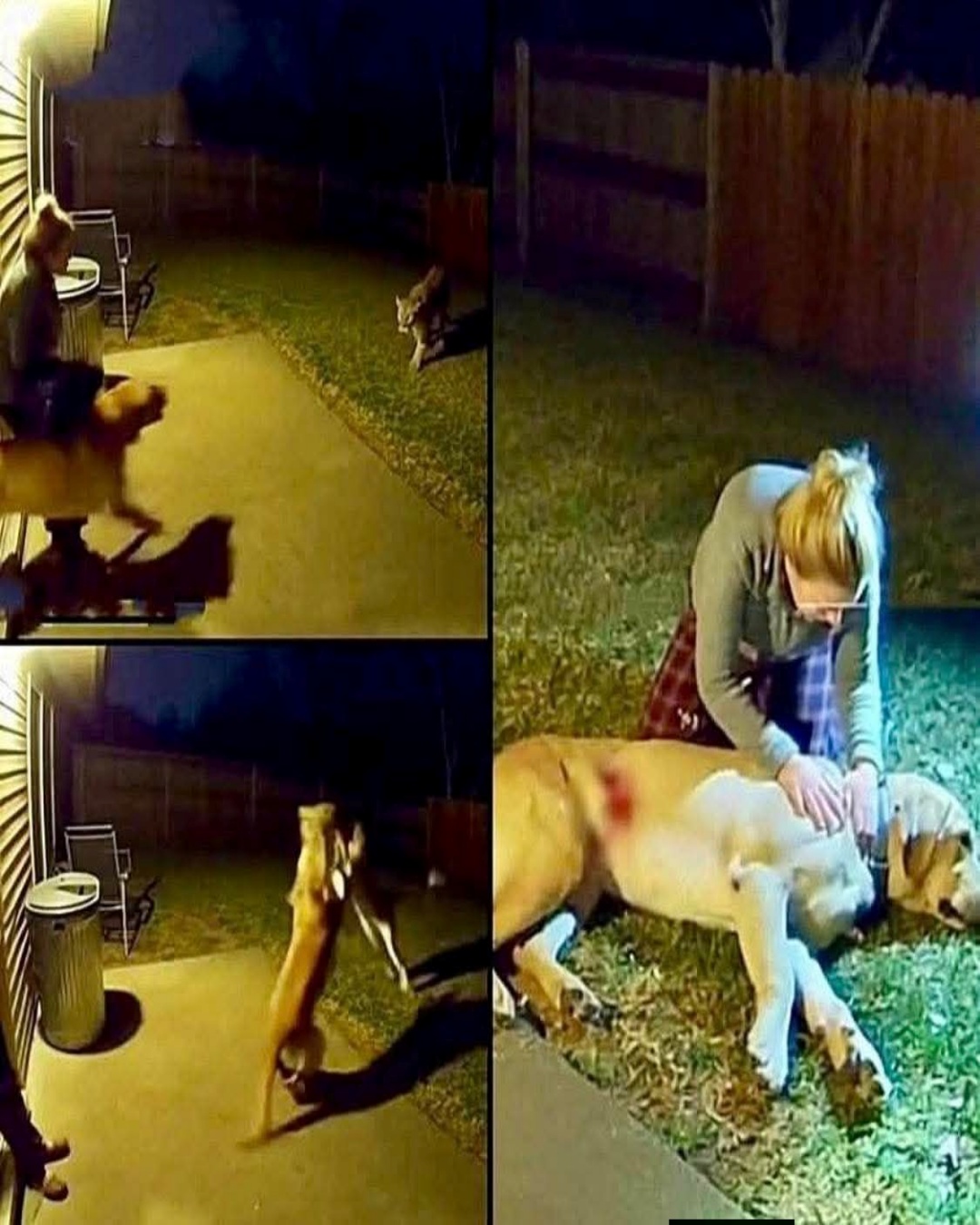
It was a peaceful evening, quiet and still, as Margaret stepped outside with a bag of trash in hand, the night air cool and calm around her. The world seemed peaceful, with no sign of danger lurking in the darkness. Little did she know, her life was about to be altered forever. She never saw the danger coming — until it was already upon her.
Without warning, a puma, swift and silent, emerged from the shadows. Its eyes gleamed with the cold, calculating focus of a predator. Margaret was caught off guard, unable to react quickly enough. The puma’s deadly presence closed in on her with terrifying speed. There was no time to flee, no place to hide. In that moment, she realized she was utterly vulnerable, facing a force of nature that could end her life with ease.
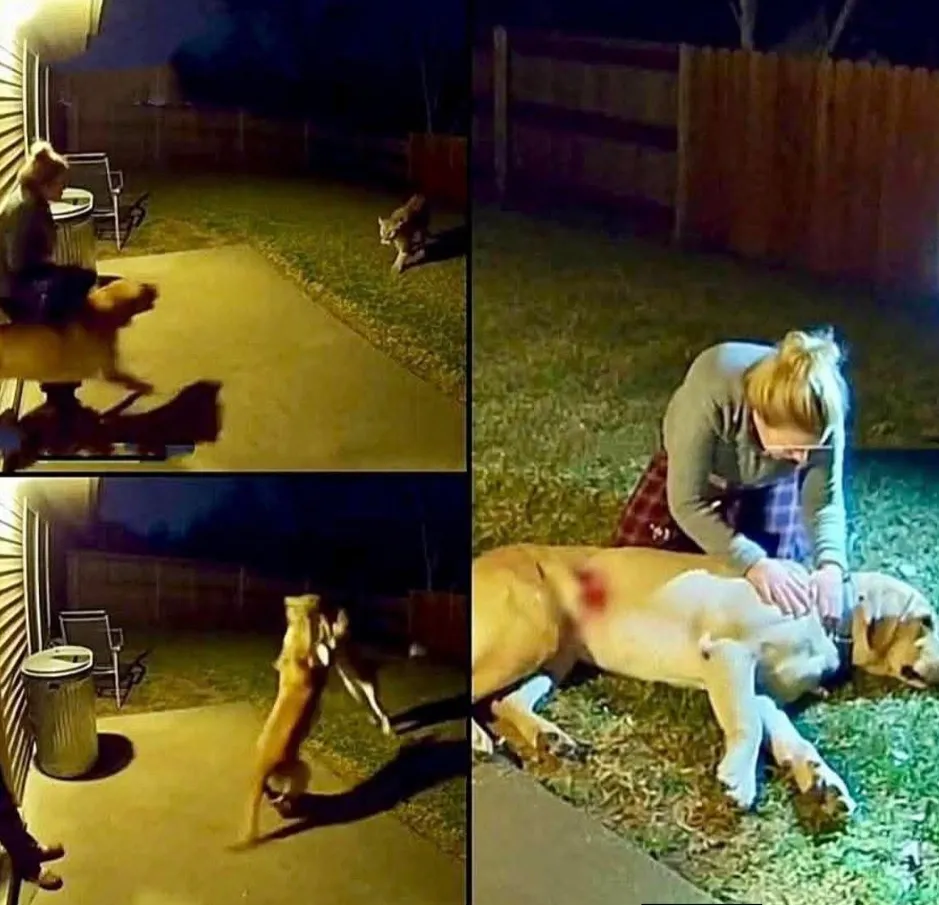
But just as the situation seemed hopeless, something incredible happened: the door to her home burst open. Buddy, her loyal yellow lab, rushed out without a second thought. He didn’t bark, he didn’t hesitate. Without even a moment of fear, Buddy moved forward, positioning himself between Margaret and the puma. He was determined. This wasn’t just a dog in survival mode — this was a dog who understood his role and purpose.
Buddy had always been there for Margaret. He had been her companion, her protector, her constant source of love and comfort. But in that moment, he became something more: her hero. He was no longer just a pet; he was her lifeline. The puma, sensing the challenge, lunged forward. The battle between the two animals began, chaotic and violent, but Buddy didn’t back down. He fought with everything he had, driven by a single, unwavering goal — to protect Margaret.
The fight was fierce, and it didn’t last long. Buddy wasn’t fighting for himself. He wasn’t concerned about the risk to his own life. His only thought was to keep Margaret safe. His love for her, so pure and loyal, fueled every move he made. The seconds felt like hours, and with each one, Buddy’s bravery earned them more time. Margaret, still in shock, managed to turn and flee to safety. Her screams pierced the night, drawing attention from neighbors, who quickly ran to her aid.
As the sounds of people rushing outside echoed through the neighborhood, the puma, faced with unexpected resistance and the approach of others, retreated into the darkness. The predator was gone, but the damage was already done. The battle had taken its toll, and Buddy, though victorious in his mission, was exhausted. His body, battered and bloodied from the fight, lay on the ground, unable to keep going.

Margaret rushed to him, her heart breaking as she knelt beside him. His body, once full of strength and energy, now lay still. She could hardly believe the selfless act of love that had just unfolded before her eyes. Buddy had given everything to save her. His loyalty, his courage, and his love for her had driven him to face the puma without hesitation. His body had fought until it could fight no more.
In that moment, Margaret’s hands trembled as she held Buddy close. She felt relief — relief that she was alive — but it was intertwined with the deepest sorrow. The dog who had always been by her side, the dog who had offered her unconditional love, had put himself in harm’s way to protect her. His sacrifice would never be forgotten.
As she held him, Margaret whispered her gratitude, her voice thick with emotion. “You saved my life,” she said, her words barely audible through the tears. Buddy, though battered and bruised, had fulfilled his purpose. His love had triumphed over fear, and in doing so, he had protected the one person who mattered most to him.
May you like

Buddy’s heroic act is a testament to the bond between a dog and their person. It is a bond built on love, trust, and devotion — a bond that is unbreakable even in the face of danger. Buddy didn’t hesitate, he didn’t doubt his ability. He just acted, knowing that his job was to protect Margaret, no matter the cost.
Though Buddy’s physical body could no longer endure, his spirit would live on in Margaret’s heart. She would carry the memory of that night with her forever, knowing that she had been loved and protected by a dog who gave everything for her. Buddy’s love was a quiet but powerful reminder that true heroism doesn’t always come in the form of grand gestures. Sometimes, it’s a dog who is willing to lay down his life for the one he loves. And that, in its purest form, is the greatest act of love.
He Sat in Silence for Months — Until Grief Broke the Rules Inside a Mecklenburg County Courtroom 6675

The courtroom inside the Mecklenburg County Courthouse was built for composure, for the careful turning of pages and the steady cadence of legal language that promises fairness through patience. On February 19, 2026, that quiet architecture of order was tested by something far older and far more powerful than procedure — a father’s grief. Shaheem Snype had been sitting in that room for months, attending hearing after hearing in the case against Marion McKnight, the man accused of killing his sixteen-year-old son, Jamariyae Snype. Each appearance required him to do the unthinkable: sit only feet away from the person prosecutors say took his child’s life. The room asked for restraint. His heart carried a storm.

Jamariyae was sixteen — an age suspended between boyhood and manhood, filled with unfinished plans and half-written dreams. His death in a shooting left an emptiness that followed his family everywhere, from the kitchen table to the quiet hallway outside his bedroom. Court became a recurring ritual of endurance. Legal arguments echoed through the chamber: motions filed, continuances requested, dates moved forward. To attorneys, these were necessary steps in due process. To a grieving father, they were reminders that justice moves slowly while grief moves all at once.
Every hearing meant reliving the worst day of his life. Every delay felt like another stretch of time without answers. Words like “adjourned” and “pending” landed differently when you were the one going home to a house that no longer sounded the same. The law is structured around fairness, around evidence and measured judgment. But loss does not measure itself in legal standards. It measures itself in silence.

Witnesses say that on that February morning, as the proceedings unfolded in familiar rhythm, something shifted. There was no dramatic warning, no shouted declaration beforehand. Just a moment — small and invisible — where months of contained sorrow pressed against the boundaries of self-control. Shaheem Snype rose from his seat and lunged across the polished wooden benches toward Marion McKnight.
The scrape of wood against tile shattered the stillness. Gasps replaced whispers. Deputies stationed in the courtroom moved immediately, intercepting him before he could fully reach the defendant. The chamber, usually governed by quiet discipline, erupted into brief chaos. Voices rose. Commands were shouted. For seconds that felt longer than they were, grief overpowered order.

Security restored control quickly. Officials later confirmed that the accused sustained visible injuries but remained in custody, and no serious additional injuries were reported. Proceedings halted. Calm returned in form, if not in feeling. But something deeper had already been exposed.
What unfolded that day was not merely a courtroom disturbance. It was a collision between two realities that rarely align: the slow, deliberate machinery of justice and the immediate, overwhelming force of parental loss. Courtrooms are designed to remove emotion from judgment. They depend on neutrality. They insist on patience. Yet for families who have lost someone to violence, patience can feel like punishment.

Time behaves differently for the grieving. Weeks stretch. Court dates loom like emotional checkpoints. Each appearance is not just about testimony or motions; it is about standing in the same space as the person accused of ending a life you loved. The system must protect the rights of the accused. It must ensure fairness, regardless of public emotion. But families sit in that balance, carrying a pain that does not pause simply because the law requires composure.
Shaheem Snype’s outburst forced the room to confront that tension in its rawest form. It raised difficult questions: How does a parent endure proximity to the accused without breaking? How long can grief be asked to sit still? And what support exists for families navigating the drawn-out path toward trial?
The answers are complex. Justice demands process. Evidence must be tested. Rights must be preserved. Without those safeguards, verdicts would carry less legitimacy. Yet moments like this remind us that behind every case number is a family whose world has permanently changed. Behind every docket entry is a name spoken at a graveside.
The Mecklenburg County Courthouse returned to order after deputies intervened. Benches were straightened. Schedules were adjusted. The case will continue through its required stages. The law will proceed as it must. But those present on February 19 witnessed something that cannot be reduced to an incident report.
They witnessed the visible breaking point of a father who has lived for months with an absence that no verdict can fully repair.
Justice is often described as blind. It weighs facts without favor. But grief sees clearly. It sees the empty bedroom. It hears the silence at dinner. It feels the passage of birthdays that will no longer arrive. For families like the Snypes, the courtroom is not just a venue for legal resolution. It is a place where memory and accusation share the same air.
There are no easy conclusions in moments like this. The legal process must continue within the bounds of law. Security must be maintained. Emotions cannot dictate outcomes. And yet, to ignore the emotional toll would be to miss part of the truth.
On that February morning, a courthouse built for restraint briefly reflected something unrestrained. It showed how thin the line can be between composure and collapse when loss is still fresh and justice feels distant. It reminded everyone present that the pursuit of accountability is not only procedural — it is deeply human.
When the doors closed and the hallway emptied, what remained was more than a case moving forward. What remained was a father still grieving, a community still waiting, and a system continuing its steady march toward trial.
In the end, order was restored.
But heartbreak does not adjourn.