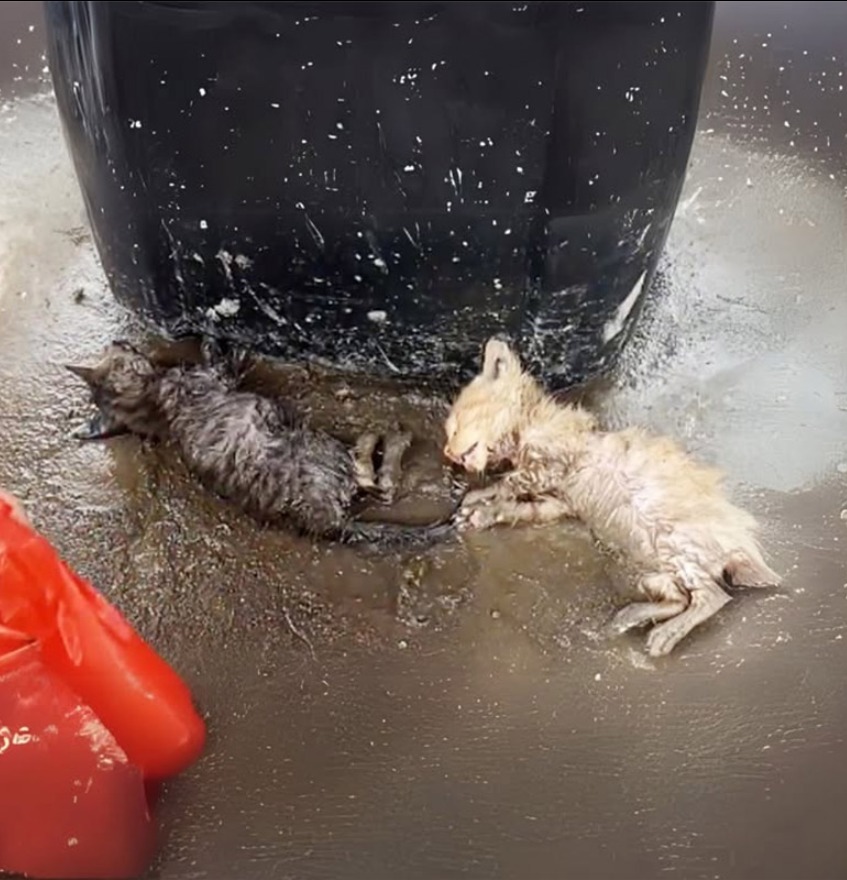
It was supposed to be an ordinary day, the kind that slips by without leaving any mark at all. I stepped outside with a trash bag in hand, my mind preoccupied with routine thoughts, never imagining that within moments my life—and the lives of two tiny souls—would change forever. As I neared the trash cans, something caught my eye. At first, I thought it was just a bundle of wet rags discarded carelessly. But then I saw movement, barely perceptible, and heard a sound so faint it almost blended into the background noise of the day.

Two tiny kittens lay beside the trash can, soaked to the bone and trembling uncontrollably. One was completely still, its small body limp and cold. The other let out a weak, desperate cry—a sound so fragile it felt like it might disappear at any moment. My heart dropped into my stomach. The sight was devastating, gut-wrenching in a way I will never forget. Someone had thrown them away as if they were nothing, left them exposed to the cold, rain, and indifference of the world.
Without stopping to think, I acted. I dropped the trash bag, scooped both kittens into my arms, and wrapped them in a plastic bag to shield them from the biting cold. I could feel how cold their bodies were, unnaturally so, and fear rushed through me. I ran back inside, my mind racing, my hands shaking, driven by one thought only: please don’t let it be too late.

Inside my home, I moved quickly, turning my living space into an emergency rescue zone. I filled a hot water bottle, wrapped it in a towel, and placed it near their tiny bodies. Gently, I patted them dry, careful not to use too much pressure, terrified that even the smallest mistake could cost them their lives. Time felt distorted—seconds stretched into eternity as I watched for any sign of movement.
Then, slowly, miraculously, it happened.
A paw twitched. A tiny chest rose and fell. A soft, raspy meow escaped from one of them. Relief flooded through me so intensely that I nearly collapsed. They were alive. Weak, fragile, barely clinging to life—but alive. That single fact gave me the strength to keep going.
As I examined them more closely, I realized just how bad their condition was. Their tiny bodies were crawling with fleas, clustered so thickly it was horrifying to see. Despite that, I couldn’t find any visible wounds or injuries, which felt like a small blessing amid the chaos. Still, they were clearly newborns, far too young to be on their own, and dangerously close to death from exposure and starvation.

I prepared a warm bath and carefully washed them, doing my best to remove the fleas without overwhelming them. They barely protested, too exhausted to resist, but as the warm water touched their skin, I could feel their bodies slowly relax. Once clean, I wrapped them in soft, old clothes and fashioned a makeshift nest—a safe, warm cocoon where they could rest.
I had never cared for newborn kittens before. Fear crept in as the reality of responsibility settled over me. I didn’t know what to do, but I knew I had to learn—quickly. I turned to online resources, watching videos, reading guides, and absorbing every piece of information I could find. How to feed them. How often. How to keep them warm. How to help them eliminate. Every detail mattered.
Feeding them was the hardest part.
At first, they refused to eat. Their tiny mouths stayed closed, their bodies too weak or frightened to accept nourishment. I tried everything—syringe feeding, warming goat milk, adjusting positions, speaking softly to them. Every attempt felt like a battle against time. Then, finally, one of them took a tiny sip. Just a drop—but it felt like a miracle.
That moment gave me hope.
Little by little, feeding sessions became more successful. Each small swallow was a victory, each completed feeding a step further away from the edge they had been standing on. Their bodies slowly began to fill out, their strength returning in fragile increments. Days passed, and with each one, they grew more responsive, more present.
The first time one of them stood on wobbly legs, I cried.
The first time they explored their surroundings, clumsily tumbling over each other, my heart swelled with joy I didn’t know how to contain. These were moments I hadn’t dared to imagine when I first found them soaked and motionless by the trash.
As their strength grew, so did their personalities. One was bolder, curious about everything, always trying to crawl farther than the other. The second was gentler, more cautious, seeking warmth and comfort. Watching them interact—curling up together, grooming each other clumsily—was deeply moving. They had survived together, and they were learning to live together too.
Wanting to give them a safe and stimulating environment, I built them a small cat cage—a place where they could play, rest, and grow without danger. Nutritious food became a daily priority, along with toys that encouraged movement and curiosity. What had once been frail, soaked bodies transformed into lively, energetic kittens bursting with life.
They chased strings with reckless enthusiasm, pounced on toys far bigger than themselves, and explored every corner of their space with wide-eyed wonder. Their once dull eyes now sparkled with curiosity and trust.

Sometimes, I would sit and just watch them, overwhelmed by how close I had come to losing them before ever knowing them. It felt unreal to think that these playful, vibrant creatures were the same kittens I had nearly assumed were already gone.
The bond we formed during those fragile early days is something profound. It’s built on trust, patience, and shared survival. They learned that hands bring warmth, not harm. I learned just how resilient life can be when given even the smallest chance.
These two kittens didn’t just survive—they transformed my life as much as I transformed theirs. They brought purpose, joy, and a constant reminder that compassion matters. That stopping, noticing, and caring can change everything.
They are living proof that even in the bleakest circumstances, hope still exists. That love, persistence, and kindness can pull life back from the very edge. And that sometimes, the most extraordinary moments come from the most ordinary days—when you take out the trash and instead, you find a reason to believe in miracles.
Out of the Shadows: The Kitten Who Found Life After the Dark
In a quiet neighborhood where life followed familiar routines, something extraordinary happened without anyone noticing at first. Cars passed. Doors opened and closed. Conversations drifted through the air. And hidden within this ordinary rhythm, a tiny kitten was fighting a battle it could not possibly win alone.

Somewhere inside a narrow utility pole, wrapped in cold metal and darkness, the kitten was trapped.
There was no light. No warmth. No sense of direction. The space was tight and unforgiving, pressing against its small body from every side. The kitten could not see where it was or how it had ended up there. It only knew fear, isolation, and the instinctive need to survive.
Time inside the pole did not move normally. Minutes felt endless. The air was still, and every sound echoed back in a way that made the kitten freeze. Its tiny body trembled, not only from the cold but from exhaustion. It cried softly at first, then quieter still, as if conserving the last of its strength.
No one knew how long it had been trapped. Perhaps it had slipped inside while exploring. Perhaps it had been chasing warmth or shelter. Like many young animals, curiosity may have led it into danger it could not escape on its own.
What mattered was that the kitten was running out of time.
The rescue began with a sound almost too faint to notice.
A passerby walking nearby paused when they heard something unusual. It wasn’t loud or obvious—just a small, persistent sound that didn’t belong to the environment. At first, it could have been mistaken for the wind or a distant bird. But it continued, steady and pleading.
Someone listened.
That moment of attention changed everything.
Emergency responders were called, and soon a small group of rescuers arrived. They approached the utility pole with care, kneeling down, listening closely. When they confirmed that an animal was trapped inside, their focus sharpened. This was not a routine task. This required patience, precision, and compassion.
They spoke softly as they worked, tapping gently on the metal to let the kitten know it was not alone. The voices were calm, reassuring, steady. The rescuers understood something important: fear could be just as dangerous as the physical trap itself.
The process of opening the pole was slow. Every movement was measured. Metal panels were loosened carefully, ensuring that nothing would shift suddenly. Inside, the kitten waited, trembling, unaware of what was happening—only sensing change.
When the opening finally widened enough, the rescuers saw the kitten.
It was smaller than expected. Thin. Cold. Exhausted.
As soon as it was lifted out, the kitten collapsed into waiting hands, no longer able to hold itself upright. It didn’t resist. It didn’t struggle. Instead, it rested there, as if surrendering to safety for the first time.
In a moment that would stay with everyone present, the kitten lifted one tiny paw and touched the rescuer’s fingers. A simple gesture. Quiet. Fragile. Yet deeply powerful.
Trust had been given.
The kitten was rushed to a veterinary clinic, wrapped in warmth, protected from further stress. Doctors worked quickly but gently, focusing first on stabilizing its body temperature and addressing dehydration. The kitten was weak, but remarkably, there were no serious injuries. No broken bones. No irreversible damage.
What it needed most was time.
Under steady care, the kitten slowly responded. Its breathing evened out. Its trembling softened. Its eyes, once wide with fear, began to focus again. Each small improvement felt significant. Every tiny movement was watched closely, celebrated quietly.
Recovery was not immediate. The kitten had endured isolation, cold, and fear—experiences that leave marks deeper than the surface. But day by day, with gentle handling and consistent care, its strength returned.
It learned that hands could bring comfort.
That voices could mean safety.
That the world, though frightening at times, was not entirely cruel.
Rescue workers noticed the change in its behavior. At first, it stayed curled up, conserving energy. Then curiosity began to emerge. The kitten explored its surroundings cautiously, sniffing unfamiliar scents, responding to soft sounds. Playfulness returned in brief moments—a clear sign that its spirit had not been broken.

The kitten’s story spread quietly, not as a spectacle, but as a reminder.
A reminder that vulnerability often hides in places we don’t expect.
That attention saves lives.
That listening—truly listening—matters.
Once the kitten was strong enough, plans were made for its future. Adoption was not rushed. The goal was not just survival, but stability. When the right family came forward, they were drawn not by sympathy alone, but by the resilience the kitten had shown.
They welcomed the kitten into their home with patience and care.

The transition was gentle. New spaces were explored slowly. Sunlight replaced darkness. Soft bedding replaced cold metal. Routine replaced fear. Over time, the kitten settled into its new life, growing more confident each day.
Today, it lives surrounded by warmth, safety, and affection. The memory of the utility pole no longer defines its life. What defines it now is comfort, curiosity, and trust.
For those involved in the rescue, the experience left a lasting impression. Not because it was dramatic, but because it was meaningful. It reinforced why rescue work exists in the first place—to protect lives that cannot ask for help in ways we easily recognize.
This kitten’s journey is not unique. Many animals face danger quietly, hidden within everyday environments. Their survival often depends on whether someone notices, whether someone cares enough to act.

The story reminds us that compassion does not require grand gestures. Sometimes it begins with pausing. With listening. With choosing to respond instead of walking away.
From darkness to light.
From fear to safety.
From isolation to belonging.
The kitten’s life was changed by a chain of small decisions—one person listening, one call made, careful hands at work, patient care afterward.
And because of that, a fragile life not only survived, but learned how to thrive.
In a world that often moves too fast, this story asks us to slow down. To pay attention. To remember that even the smallest lives matter, and that empathy, when acted upon, can transform outcomes in ways we may never forget.

The kitten who once trembled in silence now explores its world with confidence. Its eyes are bright. Its steps are steady. Its future is open.
And all of it began because someone chose to listen.
Brave Bond: Abused Dogs Form Healing Friendship, Inspire Acts of Kindness
Animals often display remarkable levels of kindness and empathy, sometimes in ways that feel strikingly similar to human compassion—and occasionally even more immediate and instinctive. One deeply moving example of this can be seen in the story of Sammie, a young boxer mix who arrived at an animal shelter in devastating condition, both physically and emotionally, after enduring severe abuse. His story is difficult to hear, yet it reveals something profoundly hopeful about the resilience of living beings and the quiet, powerful ways animals care for one another.

Sammie had faced cruelty that is hard to comprehend. He had been spray-painted, shot in the head, and dragged behind a car—acts that reflect a level of violence no creature should ever experience. By the time he was rescued, he was not only in critical physical condition but also understandably overwhelmed with fear. Dogs, like humans, can carry emotional scars from trauma. They may become withdrawn, anxious, or reactive, especially when their trust has been so brutally broken. Sammie arrived at the shelter as a victim in every sense: wounded, frightened, and unsure of the world around him.
Yet even in this state, something remarkable happened.
Another dog named Simon, who had also experienced neglect and hardship, seemed to recognize Sammie’s distress almost immediately. There was no formal introduction, no careful human-guided interaction to ease them into companionship. Instead, Simon simply made his way over to Sammie and, in a quiet, unassuming gesture, placed a paw gently on him. It was not a dramatic act, but it carried immense emotional weight. That small movement—soft, deliberate, and calm—became the beginning of a bond that would help both dogs begin to heal.
What makes this moment so powerful is how natural it appeared. Simon did not need to be instructed or encouraged to offer comfort. He did not hesitate or appear unsure. He simply responded. To an outside observer, it looks unmistakably like empathy: the ability to perceive another’s emotional state and respond in a way that provides reassurance. While scientists may debate the exact mechanisms behind such behaviors, moments like this challenge the assumption that empathy is uniquely human.

It is also worth noting that Simon and Sammie had not shared the same past, nor had they been rescued together. And yet, they seemed to recognize something familiar in each other—perhaps a shared sense of vulnerability or the lingering effects of mistreatment. Animals are highly attuned to body language, tone, and subtle behavioral cues. Where humans might rely on words, animals rely on presence. Simon likely sensed Sammie’s fear through posture, stillness, or tension, and responded in the only way he knew how: by offering closeness and calm.
From that point on, the two dogs quickly became inseparable. They stayed near each other, moved together, and provided a steady source of companionship. For Sammie, this connection was more than comforting—it was stabilizing. Recovery from trauma is rarely a solitary process. Whether human or animal, healing often depends on the presence of another being who provides safety and consistency. Simon became that presence for Sammie.
Their bond also highlights an important aspect of emotional recovery: trust does not always return all at once, and it does not always come from humans first. In Sammie’s case, it was another dog—someone who communicated in the same nonverbal language—who helped him begin to feel safe again. That sense of safety can then extend outward, eventually allowing room for positive interactions with caregivers, veterinarians, and, ultimately, potential adopters.

Meanwhile, Simon’s role in this relationship is equally meaningful. While Sammie was clearly in greater need of medical attention and rehabilitation, Simon also benefited from the companionship. Animals that have experienced neglect often carry their own forms of stress and insecurity. By forming a bond with Sammie, Simon may have found a sense of purpose or stability as well. Their relationship was not one-sided; it was mutually supportive, even if their needs differed in intensity.
The people caring for them were deeply moved by this connection. Even those experienced in animal rescue—individuals who have seen countless cases of neglect and recovery—found themselves struck by the depth of understanding between the two dogs. It is one thing to witness physical healing, but emotional healing, especially when it unfolds organically between animals, can feel almost mysterious. It challenges assumptions about intelligence, awareness, and the emotional lives of non-human beings.
Despite the progress, Sammie’s journey toward recovery was far from over. Physical injuries take time to heal, and emotional wounds often linger even longer. He required ongoing medical treatment, careful monitoring, and plenty of patience. Recovery is rarely linear; there are setbacks, moments of fear, and gradual steps forward. Yet the presence of Simon provided a foundation—a steady reminder that not all interactions lead to harm.

Simon, on the other hand, progressed more quickly and was expected to be ready for adoption sooner. This introduces a bittersweet element to the story. While it is wonderful that Simon would soon have the opportunity to find a permanent home, separating the two dogs could be challenging, given the strength of their bond. Situations like this often force caregivers to make difficult decisions, balancing the individual needs of each animal with the recognition of the comfort they provide to one another.
Still, the ultimate goal remains the same: to ensure that both dogs find loving, stable environments where they can continue to thrive. For Sammie, that path may take longer, but his story has already touched many people. Stories like his often inspire compassion and action, encouraging others to support rescue efforts, adopt animals in need, or simply become more aware of the realities of animal cruelty.
Beyond the specifics of Sammie and Simon, this story invites a broader reflection on the nature of empathy. Humans often pride themselves on their emotional complexity, yet we sometimes struggle to respond to suffering with immediacy and sincerity. We overanalyze, hesitate, or become desensitized. Animals, by contrast, often act without that layer of complication. Their responses are direct and unfiltered. When they sense distress, they move closer or offer contact. When they feel safe, they relax openly.

This is not to say that animals are “better” than humans, but rather that they remind us of something fundamental: empathy does not always require words or elaborate reasoning. Sometimes, it is as simple as presence—being there, offering quiet support, and allowing another being to feel less alone.
Sammie’s story also underscores the resilience that exists even after extreme trauma. It would be easy to assume that an animal subjected to such cruelty would never trust again. And yet, given the right environment and the right companionship, that capacity for trust can reemerge. It may be fragile at first, but it is not gone.

In the end, what makes this story so powerful is not just the suffering Sammie endured, but the connection that followed. Simon did not erase Sammie’s past or instantly heal his wounds. What he did was create a bridge—a small but vital pathway back to safety, connection, and hope. And sometimes, that is where healing truly begins.
Rescuing Hope: Michael Chour’s Fight Against Southeast Asia’s Dog Meat Trade
In Southeast Asia, the practice of trading and consuming dog meat remains a complex and deeply controversial issue, shaped by cultural traditions, economic realities, and evolving societal attitudes. In countries like Cambodia, this trade continues to exist in many regions, where dog farms often function as de facto slaughterhouses. For many observers—both within and outside the region—these conditions are distressing, raising serious concerns about animal welfare, ethics, and public health. Amid this difficult reality, however, there are individuals and organizations working tirelessly to challenge the system and offer animals a second chance at life.

One of the most prominent figures in this effort is Michael Chour, the founder of The Sound of Animals. His organization is dedicated to rescuing dogs from the meat trade and advocating for stronger protections for animals across the region. Through persistence, compassion, and hands-on intervention, Chour has become a powerful voice against practices that many believe should be reexamined and ultimately ended.
Chour’s work often brings him face-to-face with some of the harshest realities of the trade. In one particularly harrowing rescue, he encountered a dog that had been sold to a slaughterhouse and was only moments away from death. The animal was tied up tightly inside a bag, surrounded by blood and mud, treated not as a living being but as disposable cargo. Scenes like this are not uncommon in parts of the trade, where efficiency and profit can overshadow basic considerations of suffering and humane treatment.

It is difficult to imagine the fear and confusion the dog must have felt. At some point, he had likely known comfort—perhaps living in a home, receiving care, and trusting humans. Suddenly, he found himself in an environment defined by terror and pain, unable to understand how his life had taken such a drastic turn. This contrast between past safety and present danger is one of the most heartbreaking aspects of these rescues.
When Chour arrived, he acted without hesitation. Understanding that time was critical, he negotiated for the dog’s release and ultimately purchased him, securing his immediate safety. While the idea of buying animals from such situations is sometimes debated—since it can inadvertently support the system—it is often the only viable way to save an individual life in urgent circumstances. For Chour, the priority in that moment was clear: get the dog out alive.
Once freed, the dog was quickly transported to the Angkor Veterinary Clinic, where he could receive urgent medical attention. Veterinary teams assessed his condition, treated injuries, and began the process of stabilizing him. Dogs rescued from the meat trade frequently suffer from dehydration, infections, untreated wounds, and extreme stress. Immediate care is essential not only for survival but also for setting the foundation for long-term recovery.

However, rescue is only the first step in a much longer journey. Physical healing can take weeks or months, and emotional recovery often requires even more time. Recognizing this, Chour arranged for the dog to be moved to a temporary shelter in O Smach, a quieter environment where he could begin to decompress. In such settings, rescued animals are given space, consistent care, and gentle human interaction, allowing them to gradually rebuild a sense of safety.
At the shelter, veterinarians and caregivers monitored the dog closely. They ensured he was eating properly, responding to treatment, and slowly adjusting to his new surroundings. For animals that have experienced severe trauma, even small milestones—such as accepting food from a human hand or resting without fear—represent significant progress. These moments, though easy to overlook, are powerful indicators of resilience.
Once the dog’s condition improved, the plan was to transfer him to a more permanent facility operated by The Sound of Animals in Ban Kruat District, Thailand. This larger shelter provides long-term care and rehabilitation for rescued dogs, offering them a stable environment where they can continue healing and, eventually, be prepared for adoption when possible.

The work carried out by Chour and his team highlights the complexity of addressing the dog meat trade. It is not simply a matter of rescuing animals, but also of navigating cultural sensitivities, economic dependencies, and logistical challenges. Efforts to create change must balance respect for local contexts with advocacy for improved animal welfare standards. This often involves education, community outreach, and collaboration with local authorities, in addition to direct rescue operations.
What makes Chour’s efforts particularly impactful is his willingness to engage directly with the issue, rather than remaining a distant critic. By entering environments where these practices occur, he not only saves individual animals but also brings global attention to conditions that might otherwise remain hidden. Awareness plays a crucial role in driving change, influencing public opinion, and encouraging policy discussions.
At the same time, stories like this serve as reminders of the emotional lives of animals. The rescued dog was not just a statistic or a victim of circumstance—he was an individual capable of fear, confusion, and, eventually, recovery. With proper care and compassion, many dogs rescued from such conditions go on to form strong bonds with humans again, demonstrating an extraordinary capacity for forgiveness and trust.

This resilience is both inspiring and humbling. It challenges assumptions about the limits of recovery and underscores the importance of providing second chances. While not every rescue story has a perfect ending, each successful intervention represents a life saved and a step toward a more humane future.
The dedication and vision of Michael Chour are central to this progress. His work requires not only compassion but also courage, persistence, and a willingness to confront difficult realities on a daily basis. It is demanding, often emotionally taxing work, yet it continues because of a deep commitment to protecting vulnerable animals.
Ultimately, this story is about more than a single rescue. It is about the broader effort to challenge harmful practices, to raise awareness, and to inspire others to take action in whatever ways they can. Whether through supporting rescue organizations, advocating for policy changes, or simply choosing kindness in everyday interactions with animals, individuals have the power to contribute to meaningful change.

In a world where cruelty can sometimes feel overwhelming, stories like this offer a measure of hope. They remind us that even in the most difficult circumstances, compassion can make a tangible difference. And sometimes, the actions of one determined person can alter the course of a life—turning a moment of despair into the beginning of something better.